

Does Your Business Still Need a Website Now That AI Answers the Questions?
AI answers, Google profiles and Facebook pages can all put a business in front of customers. Here is what the research says about whether you still need a site of your own.
By Basin Hosting & Web Design
More owners are asking us some version of the same question. If people ask ChatGPT or Google's AI for a plumber, and the answer shows up right there on the screen, why pay for a website? Wouldn't a Facebook page and a Google profile cover it?
It is a fair question, and we build websites for a living, so we went looking for the honest answer instead of the convenient one. Here is what the research shows, including the parts that do not favor us.
The short answer
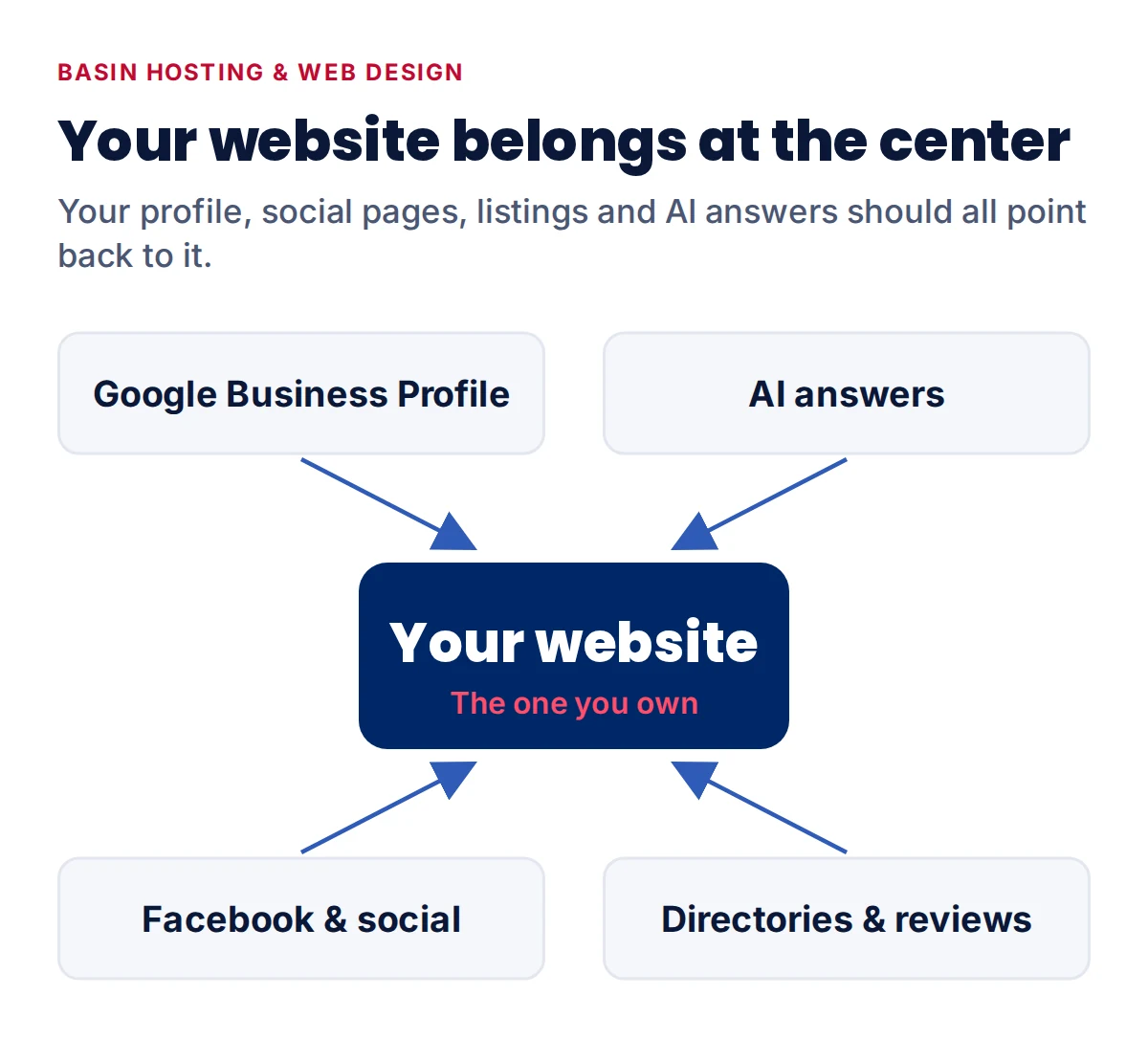
For most local businesses, yes, you still need a website. But not for the reason you might think. AI did not make websites required. What changed is this: your website is now one of the main places AI and Google go to learn about you. It is also the only one of those places you fully control.
The strongest setup is not a website instead of a Google profile and social pages. It is a website at the center, with your profile and social pages pointing back to it and saying the same thing.
What AI actually changed
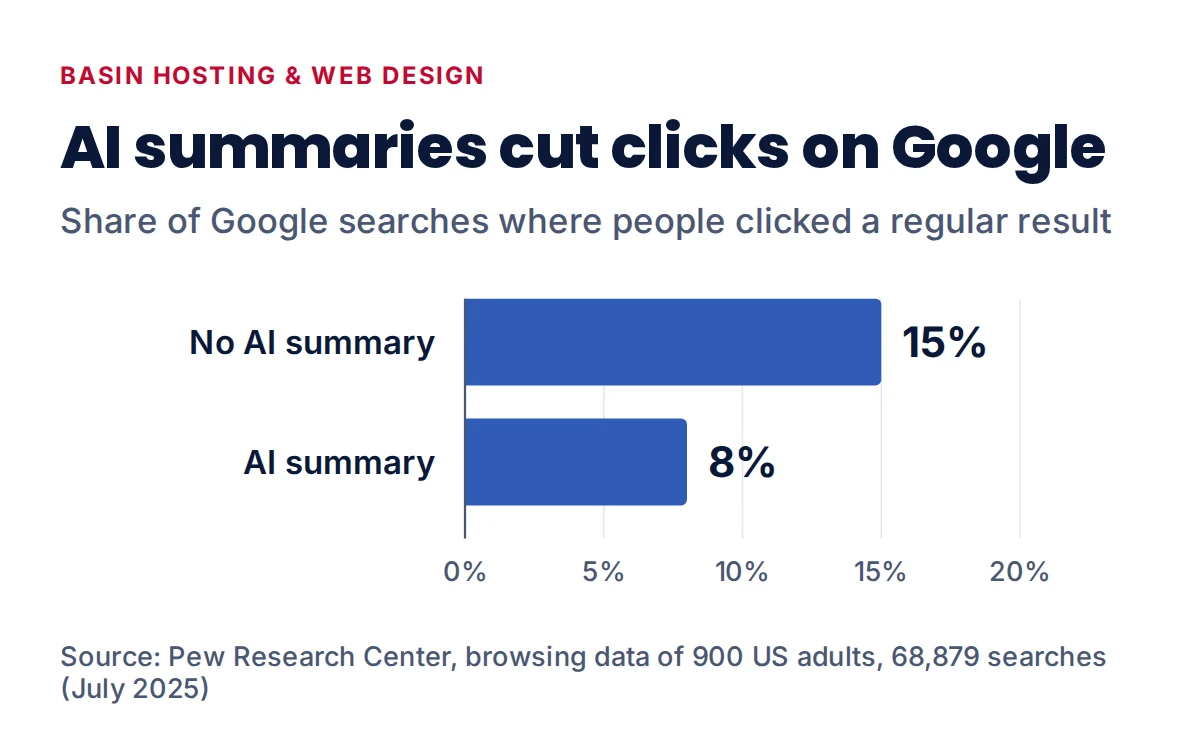
AI answers are cutting clicks. Pew Research Center tracked the real Google searches of 900 US adults in 2025. When an AI summary appeared, people clicked a regular search result in 8% of visits. When there was no summary, they clicked in 15% of visits. That is close to half the clicks gone.
But look at what kind of searches those are. AI summaries show up mostly on questions like "how do I fix a leaking faucet" or "what does a roof cost." For searches where someone wants a business near them, the picture is different. Whitespark ran 540 local searches across three large US cities in 2025. AI Overviews appeared on just 15% of searches with local intent. The map pack, the box with three businesses and a map, appeared on 93%.
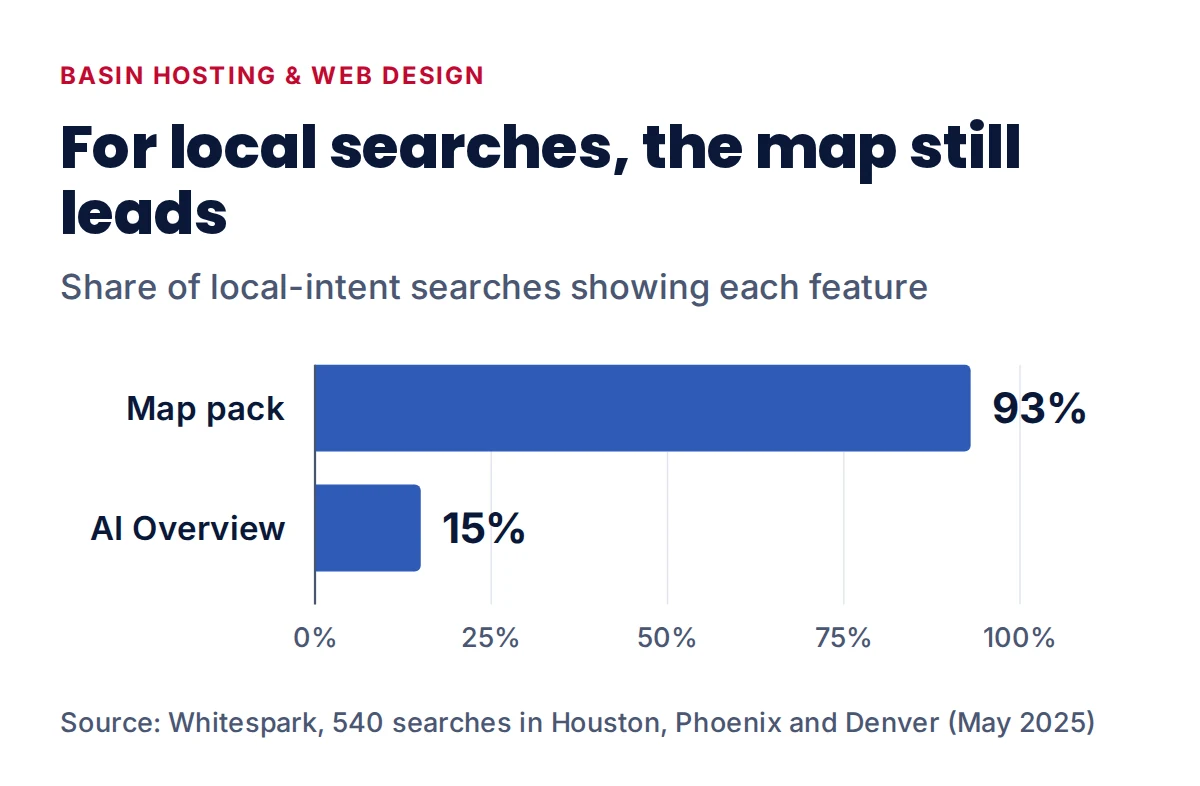
So for a customer looking for a contractor, an RV park or a party rental company in town, the map is still where the decision starts. That map runs on your Google Business Profile, and your profile is stronger with a website behind it.
Where AI gets its answers
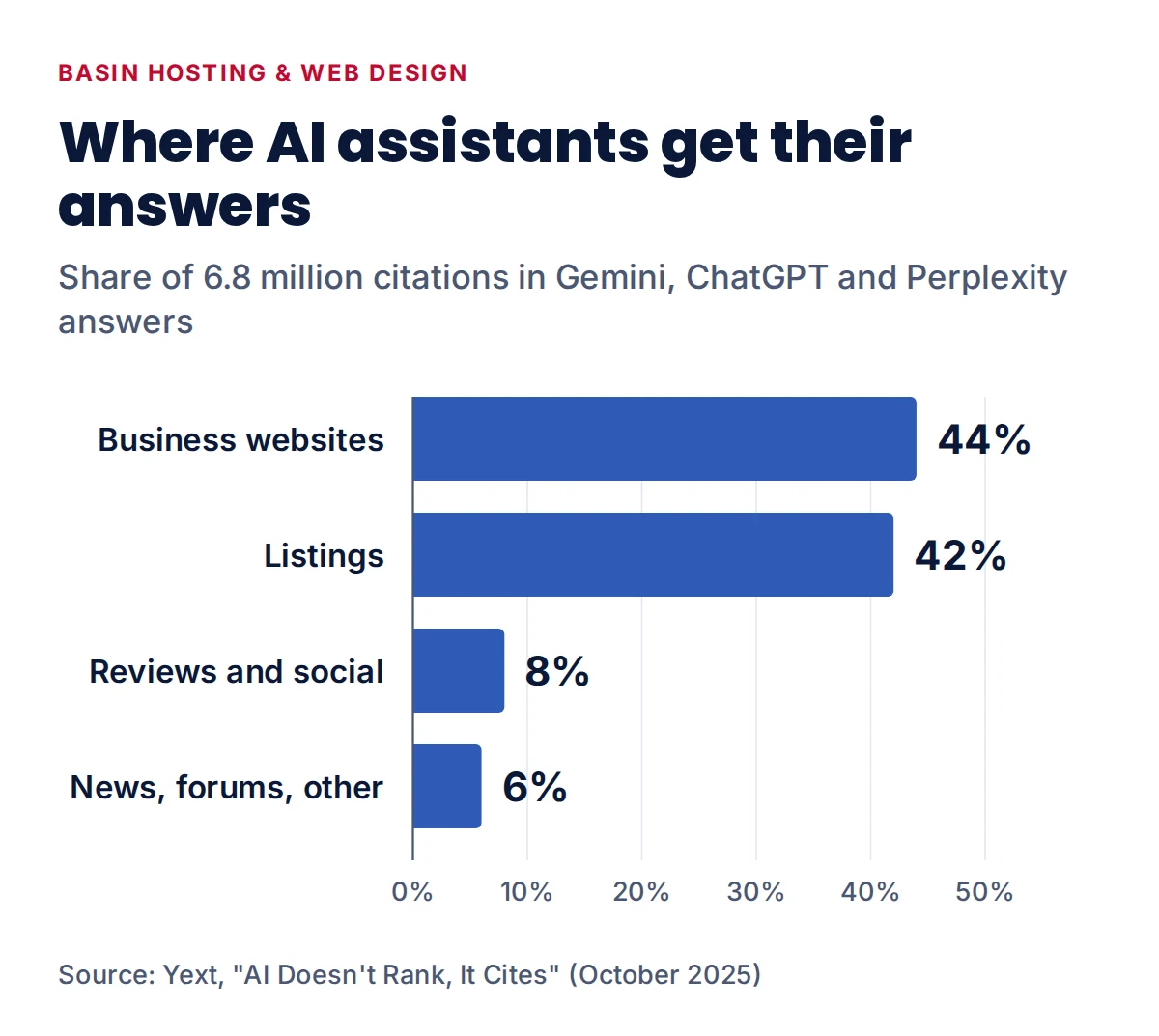
When ChatGPT, Gemini or Perplexity recommend a business, they cite sources. Yext studied 6.8 million of those citations in 2025. Websites were the largest group at 44%. Listings like your Google profile, Yelp and directories came next at 42%. Reviews and social media together made up only 8%.
Google's own guidance is worth reading closely, because it cuts both ways. Google says there are no special requirements to appear in its AI Overviews or AI Mode, and that structured data is not required. It also says a page must be indexed, meaning Google has found it and stored it, before it can show up as a source in those answers. And it says a Google Business Profile can help a business appear in AI answers.
Here is what that means in plain terms. A Google profile alone can get you mentioned. A website gives AI a fuller, more accurate picture of what you do, where you work and why someone should call you. And of all the places AI pulls from, your website is the one place no platform can edit, bury or take away.
Can a Google profile or a Facebook page be enough?
Both have real strengths, and we recommend both. The question is whether they can stand on their own.
Your Google Business Profile is the most important local listing you have. It is free, it puts you on the map, it collects reviews and it can bring in calls directly. What it cannot do is explain your work in depth. There is limited room for your services, your service area, your process or what makes you different. Google decides what shows and how. And since early 2024, Google no longer offers a simple website as part of the profile, so it is not a substitute for one.
A Facebook page or other social account is free, quick to post to and comes with an audience that already uses the app. Messages, reviews and photos are all built in. For staying in touch with past customers, it works well.
The trade-off is that you are building on someone else's land. Pages can be restricted or disabled, and getting help is hard. In June 2026, Meta's Oversight Board, the outside panel that reviews Meta's decisions, criticized the company for a "lack of transparency and consistency" in how it disables accounts. The board also faulted Meta for charging for its Meta Verified service while giving people with disabled accounts no "meaningful assistance." If your business lives only on a social platform, one decision you cannot appeal can take away your contact point, your reviews and your followers.
There is also the question of who finds you. Posts reach the people the platform chooses to show them to, and people searching Google for a service are usually not searching Facebook.
What customers do before they call
People still check. In BrightLocal's survey of local consumers, 76% said they look at a local business's website at least half the time before choosing one. And 56% expected the website to have the most accurate contact information. That survey is from 2019. It is still the most recent of its kind we could find, so treat the exact numbers with care. The habit it describes has not gone away. A customer who finds you on the map, in an AI answer or on Facebook often wants to see a real site before picking up the phone.
Most of your competition already has one. Clutch reported in 2025 that 83% of small businesses have a website, up from 64% in 2018. Among those without one, over a third said they rely on social media or marketplaces instead.
When you might not need a website
To be fair, there are businesses that can do without one, at least for now:
- A side business or hobby that is not trying to grow.
- A trade that runs entirely on referrals, with a full schedule and no interest in new customers.
- A business that takes every job through a platform that handles the booking, so customers never look for it directly.
If that describes you, a complete Google profile and an active social page may be all you need. If you want new customers who do not already know your name, it probably is not.
How to decide for your business
Ask yourself these questions:
- Do new customers find you by searching, or only by word of mouth?
- If your Facebook page or Google profile disappeared tomorrow, how would people reach you?
- Do you offer more services than your Google profile can explain?
- Do you want to run Google Ads, or know which calls came from where?
- When someone compares you with a competitor who has a good website, how do you look?
If you answered "searching" to the first question, or did not like your answer to the second, a website is worth it.
What a website has to do now
A website in the age of AI does not need to be fancy. It needs to be clear and consistent:
- Say plainly what you do and where you do it, in words a customer would use.
- Match your Google profile: the same business name, phone number, hours and service area everywhere.
- Be fast and easy to use on a phone, with your number one tap away.
- Be visible to Google. If Google has not found and stored a page, AI answers cannot point to it.
The bottom line
AI did not replace the small business website. It made it more important that your website exists, says the right things and agrees with everything else online about you. Your Google profile gets you on the map. Your social pages keep you in touch. Your website is the one asset you own, and it is the source that ties everything together.
We have built and managed websites for businesses in Midland, Odessa and across the Permian Basin since 2006. If you are not sure whether your current site, or your lack of one, is costing you customers, we are happy to take a look.
Sources: Pew Research Center, "Google users are less likely to click on links when an AI summary appears in the results" (July 2025); Whitespark, "The Prevalence of AI Overviews in Local Search" (May 2025); Yext, "AI Doesn't Rank, It Cites" (October 2025); Google Search Central, "AI features and your website" and "Optimizing your website for generative AI features"; Oversight Board decision as reported by TechCrunch (June 2026); BrightLocal, "Local Business Websites" survey (2019); Clutch, small business website survey (August 2025); Search Engine Journal on Google turning off Business Profile websites (February 2024).